


I wasn’t cold
The first time it happened, I wasn’t cold. I wasn’t nervous or in danger either. It was summer of 2000-and-something, and my family and I were deep into our annual 9-hour car journey to visit family in Ireland.
I still remember it now: the fragile clack of the case, the rewarding click of its opening, the cautionary wipe of the t-shirt on the CD, the grateful whir of the car accepting its entry, and the goosebumps that I got when I first heard The Pogues’ cover of Eric Bogle’s ‘And The Band Played Waltzing Matilda’.
It’s a languid, remorseful account of an Australian who looks back on his youth, where he was maimed in the Gallipoli Campaign of World War I. It’s a banjo, trickling from a G chord to a C chord, paired by a swelling accordion and McGowan’s unmistakably slurry yet woozy vocal twang.
As it played, the hairs stood up on my arm. I felt a tingle shell out around my neck and shoulders. I didn’t understand the lyrics really. It was boiling in the car.
So, in the absence of all of the classic variables that we know give us goosebumps, why did a melody give me them anyway?
The frisson phenomenon
‘Frisson’ means ‘shiver’ in French. The phenomenon is described by Huron and Margulis (2011, p. 591)1 as “a musically induced affect that shows close links to musical surprise”.
Although there’s a tidy word for the feeling, the science that scaffolds frisson is slightly more complex. Juslin2 cites that there are eight components that make up this phenomenon that span across social, autobiographical, psychophysiological and psychological factors.
Here are some of the most interesting:
Brainstem reflexes. Sometimes, our body reacts before we’ve made sense of the music. Sudden changes such as loudness, tempo or frequencies can trigger a spike in our automatic nervous system, which leads to heart rate rises or goosebumps. In other words, frisson can begin as a built-in startle/alert response that music translates into pleasure.
Rhythm entrainment. A song’s rhythm pulls your body into sync; tapping, swaying, micro-adjusting timing and muscle tension. All of this synchronisation can raise arousal and ‘readiness’, making you more physically responsive when a musical peak arrives.
Visual imagery. Music prompts inner film. Some sounds generate vivid mental pictures - landscapes, faces, scenes, narratives - and those images can carry emotional force strong enough to trigger chills. For some people, frisson arrives when the imagination “locks in” and the music suddenly feels cinematic, symbolic, or personally meaningful.
Episodic memory. A track is a time machine. Music is unusually good at pulling up specific life moments (where you were, who you were with, what you felt). When a memory is emotionally loaded, chills can show up as the body’s stamp of significance - not because the chord is magical, but because it opens a door to something real.
These inputs aren’t just limited to music; film, art, speech, ritual and other occasions can all trigger frisson in the body, which, in short, is our vestigial armour and arousal response. Our bodies are quite literally inflating for threat or importance.
If the body uses this response for survival-led salience, then musical frisson implies that the brain is tagging that particular moment as ‘significant’.
Prediction, violated beautifully
In my 2024 essay The Science of Music Taste, I cited Dr. Valorie Salimpoor’s theory of unpredictability as a reason why people like certain types of music:
“Salimpoor deduced that when people listen to unfamiliar music, their brains process the sounds through memory circuits, searching for recognisable patterns to help them make predictions about where the song is heading. The dopamine hit comes from having their predictions confirmed — or violated slightly, in intriguing ways.”
The science of music taste: why we like what we like
·I can vividly remember the first time I realised music taste was a thing.

Pleasure involves anticipation and payoff, and we see this a million times over on dance floors around the world.
The DJ is arguably the archetypal prediction engineer. Think back to that relieving vocal that arrives after a prolonged instrumental, the fake drop, the sudden key shift, the keys that come in at the moment you anticipated them to.
Musical goosebumps live under the same theoretical lens as music taste; when our predictions are snubbed or resolved, our bodies react.
My frisson, not yours
It’s different notes for different folks, however. Although impossible for me to comprehend, not all of you will get the same goosebumps during ‘And The Band Played Waltzing Matilda’ that I experience.
Reading Sloboda’s 1991 paper3 on the diversity of physical reactions to music, it’s clear that although the physical nature of frisson is an innate phenomenon, the things that trigger it are learned, and as a result, subjective.
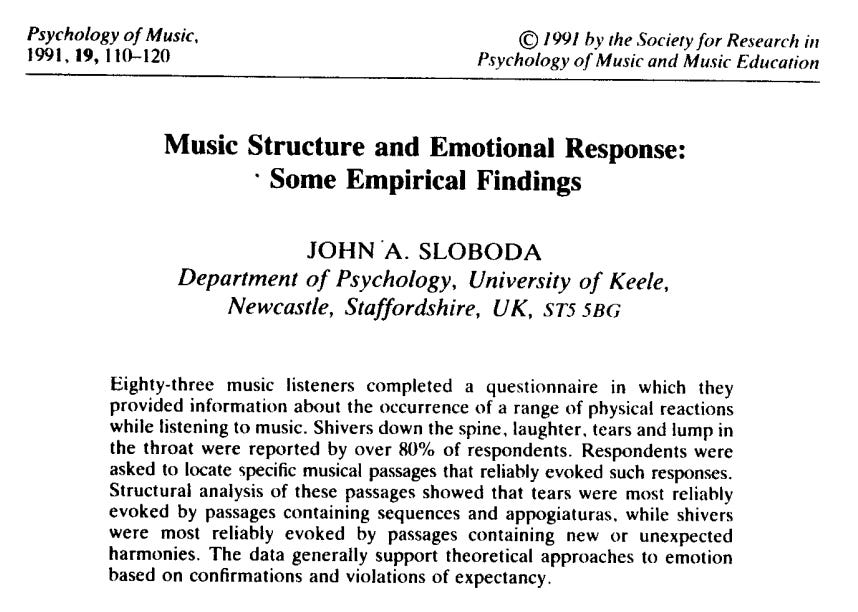
Sloboda examined people’s reactions to Western Classical music. The findings cite that although most of the subjects experienced frisson, young children or those from different cultures do not share these physical reactions to the same music.
“The structures mediating these responses are often only perceptible in terms of musical syntax; for instance, there is no way of perceiving a cycle of fifths harmonic progression unless one has internalised the system of tonal relationships and hierarchy inherent in Western music.”
So, goosebumps are innate, frisson is learned. They’re conditioned by lived experience: memory, identity, subculture.
My most recent experience of ‘learned’ goosebumps came whilst I was in the cinema last week. I was watching Joachim Trier’s latest film Sentimental Value.
Agnes has paid a visit to her older sister Nora’s house to try and scoop her out of a depressive state. The script went as follows:
Nora: You turned out fine, and I became fucked up.
Agnes: That’s not true.
Nora: Why didn’t our childhood ruin you?
Agnes: It hasn’t always been easy for me.
Nora: But you’ve managed to make a family. A home.
Agnes: There’s one major difference in the way we grew up: I had you.
My partner and I are both the oldest siblings, and this scene sent shivers, chills, even tears through both of us. It was an unlocking of a relationship dynamic we’d both experienced: although we’d like to think neither of us became ‘fucked up’, we both immediately felt recognised, acknowledged in some way by a piece of screenwriting.
Being the oldest sibling means doing things first, it means not having a fellow ‘child’ to confide in for senior advice, it means that we may have been more impactful and important to our younger siblings than we might have realised.
In this way, I see goosebumps as our bodies’ way of owning art.
A song or film or painting is out there for everyone. It’s something that all of us can have a relationship with.
But our bodies and memories are ours alone, and so the different ways that we can attach to that work are a million times over. All unique. All in some way our own.
Take part in my experiment: The Goosebump Map
Insanely, there are nearly 2000 of you reading my writing, across every continent. I’d love to test the flexibility and variability of frisson with you all.
I want to build a small, subscriber-sourced cathedral out of other people’s nervous systems, to test the following hypotheses:
Do we all get goosebumps from music?
Are there songs that surpass cultural/continental borders & affect all of us?
Is frisson more universal than the existing research suggests?
I’d love for you to share tracks that gives you frisson - the moment the room tilts, the throat tightens, the skin tickles. Not your favourite song. Not the “best” song. The one that still gets you, even when you know it’s coming.
Reply in the comments with the below. Share as many as you’d like.
Artist – Track
Where it happened
What happens to you
Why it hits
I’ll then add your answers to our Goosebump Experiment playlist, which can then act as an atlas of the tiny edits, swells and wrong-right notes that make us glitch in the best ways.
By listening to it, we’ll hopefully understand more about the universality and/or the subjectivity of musical goosebumps.
I’ve kicked things off - this playlist contains 40-50 songs that give me goosebumps. I will add yours to it as they come in.
Here are a few specific examples from my list:
Track: Efdemin - ‘Parallaxis (Traumprinz’s Over 2 The End Version)’
Where it happened: On the way to a university lecture, listening to the best mix of all time, Giegling Mix 07
What happens to me: I well up when the drums come in
Why it hits: It reminds me of my first days getting into electronic music
Track: Ratatat - ‘Cherry’
Where it happened: On a rooftop at midnight in Chiang Mai
What happens to me: I get a rush of emotion at the 3.5 minute mark
Why it hits: it’s one of those songs that tells me ‘everything’s alright’
Track: Planxty - ‘The West Coast Of Claire’
Where it happened: A cover in Brendan The Navigator, an Irish Pub in London
What happens to me: I get stunned into silence
Why it hits: The guy performing it was an unnamed local, but he had one of the best voices I’ve ever heard. The video of all of it is below - you won’t regret watching it. Is he Cameron Winter’s dad? Crazy vibrato.
You can read my other essays here.
Huron, D., and Margulis, E. H. (2011). “Music expectancy and thrills,” in, Handbook of Music and Emotion: Theory, Research, Applications, eds P. N. Juslin and J. A. Sloboda (New York: Oxford University Press), 575–604.
Juslin, P. N. (2013). “From everyday emotions to aesthetic emotions: towards a unified theory of musical emotions.” Phys. Life Rev. 10, 235–266. doi: 10.1016/j.plrev.2013.05.008
John A. Sloboda (1991). “Music Structure and Emotional Repsonse: Some Empirical Findings.” The Society for Research in Psychology of Music and Music Education
Excellent essay , very thought provoking.
Pretty Vacant by the Sex Pistols
I found them after seeing them on the Bill Grundy show ! In 1977.( worth a google !)
The opening bars make me feel like diving into the mosh pit again .
It’s a physical reaction and takes me back to discovering Punk and the feeling of energy invincibility and realising there could be other ways to be , for the first time .
Little Jesus , Gently Sleep
By my son and his friend in their junior school nativity .
It hit me that such precious innocence and naïveté is so short lived .
It makes me sob while feeling pure joy .
Great essay. The version of Efdemin's Parallaxis is wonderful!